

The origin of the tarot card deck is still unknown and debated to this day. Some have presumed it originated in Egypt; believing tarot cards certainly are a derivative of the Book of Enoch or Thoth (Tarot). Still others believe Gypsies were in charge of the widespread usage of the tarot, and in all probability, the reason why tarot readers are often portrayed as Gypsies on television or in movies to this day.
What we can say for certain is tarot decks first appeared in early fifteenth century Europe, and one that still exists, originated from Italy. During the Italian Renaissance period, the tarot deck was used for the card game Tarocchi (similar to the game of Bridge), and its own use for divination or fortune telling purposes didn't occur until three centuries later.
Here is the history of tarot cards in synopsis form, however the truth lies in the mystery of the tarot.
In the late 1700's, Antoine Court de Gebelin believed the tarot deck contained secret meanings veiled within its symbolism and drew a parallel between your Hebrew alphabet, which contains twenty-two letters, to the twenty-two cards comprising the Major Arcanum. In this same era, a guy named Etteilla (his actual name Alliette spelled backward) started to divine information from the cards, which eventually resulted in his publishing a book on these interpretations.
In the nineteenth century, Alphonse Louis Constant (aka Eliphas Levi), was convinced the true origin of the tarot was far earlier than the fifteenth century. Levi took what de G�belin had surmised; adding his belief that the ancient teachings found in the Hebrew mysticism or esoteric teachings of the Kaballah / Qaballah / Kabala; specifically the ten globes of the Sephiroth and twenty-two Hebrew letters, when combined, form the thirty-two Paths of Wisdom because the Tree of Life. In turn, this correlated to the symbolism contained within the twenty-two major Arcana and the ten minor Arcana.
So what can tarot cards do?
Hidden in the symbolism of the seventy-eight cards that comprise a tarot card deck are secrets of the Universe, the evolution of humankind, the mythological and psychological archetypes of each human being, spiritual enlightenment, and so much more. More? Isn't that enough?
Perhaps no one in their right mind wants to know this much information; in the end, our lives are complicated enough. However, as an added bonus, tarot cards reveal our future, and who doesn't want to know that? Thus, the irony is two-fold. Connected with our wanting to know the near future, the tarot deliciously entices us to feed, and we are satiated, albeit temporarily, all the while veiling our greater have to "know thyself," which is an ideal and eternal nourishment for our mind, body, and soul-spirit.
For many, the tarot is those mysterious cards that folks use to inform one's past, present, and future. For most others, they are those wondrous cards that guide one to a greater understanding of the self. Actually, the tarot is both of these. One does not exist without the other, as a greater understanding of one's self is achieved through the experiences of one's past, present, and what one creates as their future.
Asking questions of the tarot cards
Questions come in myriad forms. Although a question is normally simple and straightforward, sometimes, like an onion, you can find layers. Among this is "Will I find true love?" "AM I GOING TO understand this job or that?" "AM I GOING TO make a bundle?" However, if we look at the underlying layer of the same questions, we see "Why haven't I found true love?" "What type of work would I enjoy do?" or "Will creating a bundle really make me happy?"
Many who seek a tarot card reading achieve this to be able to receive answers to the first set of questions. That is all well and good; however, these answers are often a band-aid for a gaping wound. Often, we go from one relationship to some other or job-to-job- exceptional same result each and every time: We are still unhappy and the wound continues to grow in size and intensity of pain or discomfort. At some stage the band-aid will not work anymore, sufficient reason for any luck, we become aware of a pattern inside our lives; one that repeats itself by exceptional same pain, hurt, disappointment, or anger. The reason behind this unhappiness and repetitive life pattern is that people are not getting to the root of the issue; the underlying layer, as demonstrated in the second set of questions.
Pain and suffering has a method of getting our attention. Once we opt to accept responsibility for our decisions and conscious choices in life and turn our focus to "how do i improve or change myself" and less on, "it happened if you ask me again" or "they did this or that if you ask me," we can commence to live a happier life.
Whenever we ask a question of the tarot, we might receive an answer that we most need to hear, and not necessarily the one you want to hear. The specific reason for tarot cards would be to get us to the main of our being and bring the enlightenment of greater self-awareness. Once self-discovery is achieved, achieving the goals as organized in the first set of questions can be more apparent, and hopefully, less painful while in process and with a more joyous outcome.
The beauty of the Tarot is that it could and does answer both forms of questions. Being available to receive its wisdom may be the key.
It is feasible for one can re-direct their behavior, thereby avoiding an unpleasant event. However, additionally, there are occasions where we ostensibly haven't any control or a meeting is "fated" to occur.
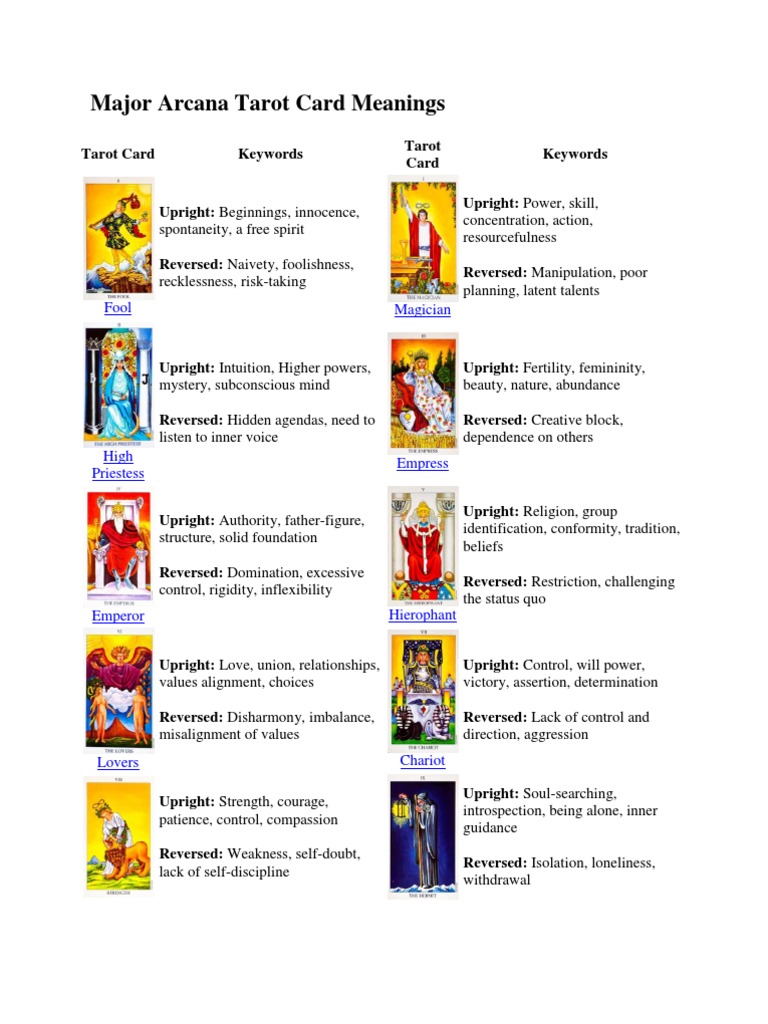
Less experienced tarot card readers
A majority of tarot card readers make the error of wanting to read/interpret tarot cards as though they were reciting words from a dictionary page. In other words, these readers offer an arbitrary list of meanings associated to a card (s), which in context isn't accurate, detailed, or specific to one's issues and/or current-future life events.
For instance, if one's concern is, "My boyfriend/girlfriend and I are having an extremely rough time at this time, and I think he/she is seeing another person. Are my feelings correct?" In this instance, let us say the tarot card "Death" comes up in this reading. The "Death" tarot card has several meanings, two of which are "change" and "ending." Then, this reader/interpreter's one-line answer is, "your relationship is either changing or ending".
Neither this statement, nor these meanings give an accurate description or answer to this concern, because they both mean completely different things. May be the relationship undergoing a big change, or could it be ending? Which one is it, or could it be neither?
In reality, each tarot card has multiple meanings related to it, which, is applicable to varied events, situations, people, feelings, thoughts, one's spirituality-spiritual path, the evolution of your respective soul, occupations, locations, parts of the body, etc-therefore, a myriad ways in which to interpret it.
Timing with tarot cards
We have been a society run by time, and it makes sense that nearly everyone who receives a tarot reading wants to know "when."
Time is a relative term, and similarly, it really is so in the tarot. Stating emphatically something will happen in June or July does a couple of things: It generates hope and expectation, or conversely, fears and dread. The tarot doesn't value time; it cares about the value of time. Therefore, enough time it refers to could be June or July this year, June or July 2 yrs from now, or the function may happen tomorrow. It could also never happen; we simply have no idea. There are tarot card meanings mixed up in grand scheme of our life's enfoldment, together with people that have which we enter into contact. Make an effort to remain open and use timing as a guidepost, not just a rule.